
Introduction
For many Indian farmers, the increasing cost of seeds, fertilizers, pesticides, irrigation, labour, and other agricultural inputs has become a major challenge.
At the same time, farmers are looking for farming methods that can help maintain soil health while reducing unnecessary dependence on costly external inputs.
Natural farming offers a practical approach to reducing input dependency by making better use of locally available farm resources, crop residues, organic matter, beneficial microorganisms, and traditional farming knowledge.
Natural farming does not mean changing everything overnight. Farmers can begin step by step, observe the results, and gradually develop a farming system that is better suited to their soil, crops, climate, and available resources.
Where Does the Cost of Farming Come From?
Before reducing farming costs, it is important to understand where most of the money is being spent.
Common farm expenses include:
- Seeds and planting material
- Chemical fertilizers
- Chemical pesticides and herbicides
- Organic inputs purchased from outside
- Irrigation and electricity
- Labour
- Machinery and fuel
- Transportation
- Crop protection and other farm operations
Not every expense can be eliminated, but many unnecessary or avoidable input costs can be reduced through better planning and efficient use of farm resources.
Start with Your Soil
Healthy soil is the foundation of productive farming.
Instead of depending only on external inputs, farmers should first understand the condition of their soil.
Consider:
- Soil testing where appropriate
- Organic matter levels
- Water-holding capacity
- Previous crop history
- Crop residue availability
- Nutrient requirements of the next crop
A soil-focused approach can help farmers apply inputs more carefully rather than using them without knowing what the soil actually needs.
Reduce Dependence on Purchased Fertilizers
One of the major opportunities for reducing farming costs is to make better use of resources already available on the farm.
Farmers can recycle suitable agricultural and biodegradable materials through:
- Compost
- Farmyard manure
- Vermicompost
- Crop residues
- Green manures
- Properly prepared natural farming inputs
The objective should not simply be to replace one purchased product with another.
The larger goal is to build a farming system where the farm itself produces more of the resources it needs.
Turn Farm Waste into Farm Resources
Crop residues, leaves, animal manure, and other biodegradable farm materials are often treated as waste.
With proper management, many of these materials can become valuable resources for the farm.
For example:
Crop Residues → Compost → Organic Matter → Healthier Soil → Better Farm Resource Efficiency
Instead of burning or unnecessarily removing suitable crop residues, farmers can explore ways to recycle them safely and appropriately.
This can reduce waste while helping return organic matter to the soil.
Make Compost from Locally Available Resources
Composting is one of the simplest ways to recycle biodegradable farm materials.
Depending on availability, farmers can use materials such as:
- Crop residues
- Dry leaves
- Farmyard manure
- Vegetable waste
- Other suitable biodegradable materials
Good composting requires proper moisture, aeration, carbon-nitrogen balance, and decomposition time.
The finished compost can then be used as part of a soil-health management program.
Use Natural Farming Inputs Wisely
Traditional natural farming practices include preparations such as Jeevamrit and Ghan Jeevamrit, which are used by many practitioners to support soil biological activity.
However, farmers should avoid treating any single input as a universal solution.
The effectiveness of a farming practice can depend on:
- Soil condition
- Crop
- Climate
- Water availability
- Application method
- Existing farm management practices
Therefore, farmers should learn the correct preparation and application method and observe their own field results.
Reduce Chemical Dependency Gradually
Moving toward natural farming does not necessarily mean stopping every existing practice on day one.
A practical transition can be gradual:
Observe → Plan → Start Small → Monitor → Improve → Expand
Farmers can begin with a small area of land, compare the results with their existing method, and learn what works best for their farm.
This approach can help reduce risk while gaining practical experience.
Use Mulching to Save Farm Resources
Mulching is another useful practice that can support efficient farm management.
Suitable organic materials such as straw, dry leaves, and other crop residues can be used as mulch depending on the crop and local conditions.
Mulching can help:
- Reduce evaporation
- Conserve soil moisture
- Suppress some weeds
- Moderate soil temperature
- Add organic matter as suitable materials decompose
Better moisture management can also contribute to more efficient use of irrigation water.
Choose Seeds Carefully
Seed selection can have a significant effect on farming economics.
Farmers should consider:
- Crop suitability for the local climate
- Soil conditions
- Disease resistance where applicable
- Seed quality
- Local and traditional varieties where appropriate
- Availability of reliable planting material
Where legally and agronomically appropriate, farmers may also learn seed-saving practices for suitable crops.
Good seed planning can reduce unnecessary re-purchasing and improve crop establishment.
Diversify the Farm
Growing only one crop can increase dependence on a single production cycle.
Depending on local conditions, farmers can consider:
- Crop rotation
- Intercropping
- Mixed cropping
- Including legumes
- Integrating livestock where practical
Diversification can improve resource use and may help spread production risk.
The right combination should always be based on the farmer’s land, water, climate, market, and management capacity.
Start Small and Learn from Your Own Field
Every farm is different.
A method that works well in one location may need modification in another because soil, rainfall, temperature, water availability, crop variety, and management practices can differ.
Therefore, farmers should consider starting natural farming practices on a manageable area.
Record:
- Input used
- Input cost
- Labour requirement
- Crop growth
- Pest and disease observations
- Irrigation requirement
- Yield
- Total cost
- Net return
This creates a valuable learning record for the next season.
Natural Farming Is About Building a Farming System
Natural farming should not be viewed simply as replacing chemical fertilizers or pesticides with another product.
A successful low-cost farming system can involve:
Healthy Soil + Local Resources + Crop Diversity + Proper Water Management + Recycling + Observation + Farmer Knowledge
The objective is to gradually create a farm that depends more intelligently on its own resources and less unnecessarily on expensive external inputs.
A Simple Low-Cost Farming Approach
Farmers who want to begin can consider this basic roadmap:
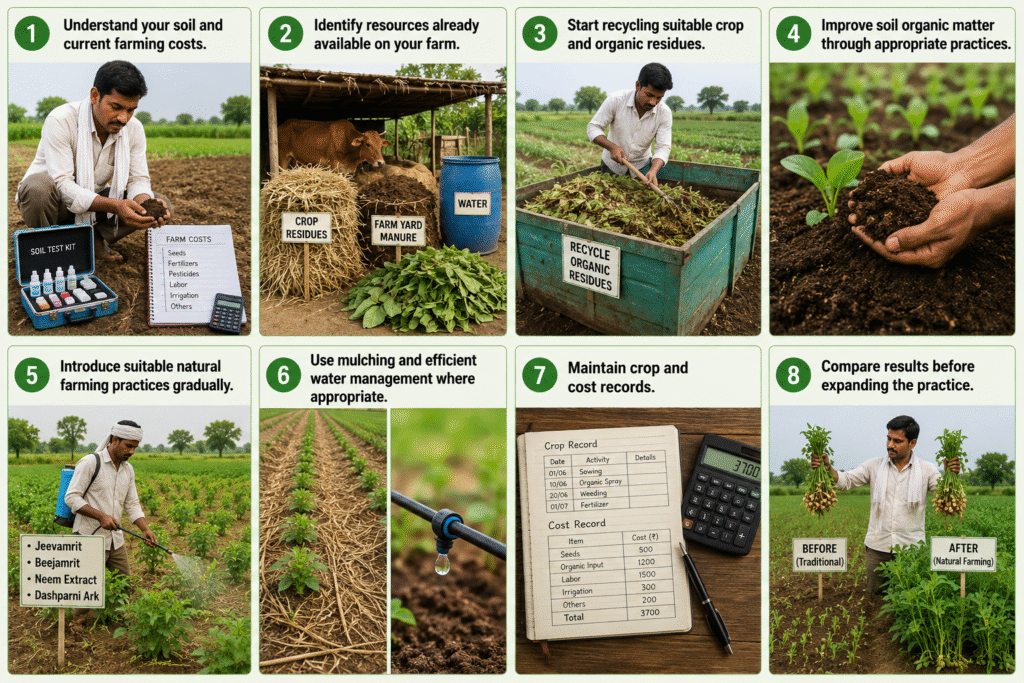
Reducing farming costs does not happen through one product or one technique.
It comes from better farm planning, healthier soil, efficient use of water and resources, recycling farm materials, reducing unnecessary external inputs, and continuously learning from the field.
Natural farming provides an opportunity to move toward a more resource-efficient and sustainable farming system.
For Indian farmers, the journey can begin with a simple question:
“What resources do I already have on my farm, and how can I use them more effectively?”
At IOFI – Infield Organic Farming India, our goal is to promote practical knowledge that helps farmers understand natural and organic farming and make informed decisions for healthier soil, sustainable agriculture, and a better farming future.
Healthy Soil. Natural Farming. Sustainable Future.
Want to start reducing your farming input costs?
Start with one small step on your farm, observe the results, maintain proper records, and gradually build your own sustainable farming model.
Follow IOFI for more practical knowledge on natural and organic farming.
Copyright © 2026 IOFI – Infield Organic Farming India. All Rights Reserved.
This article is original educational content created for IOFI – Infield Organic Farming India. Reproduction, republication, or redistribution of this content without prior written permission from IOFI is not permitted.